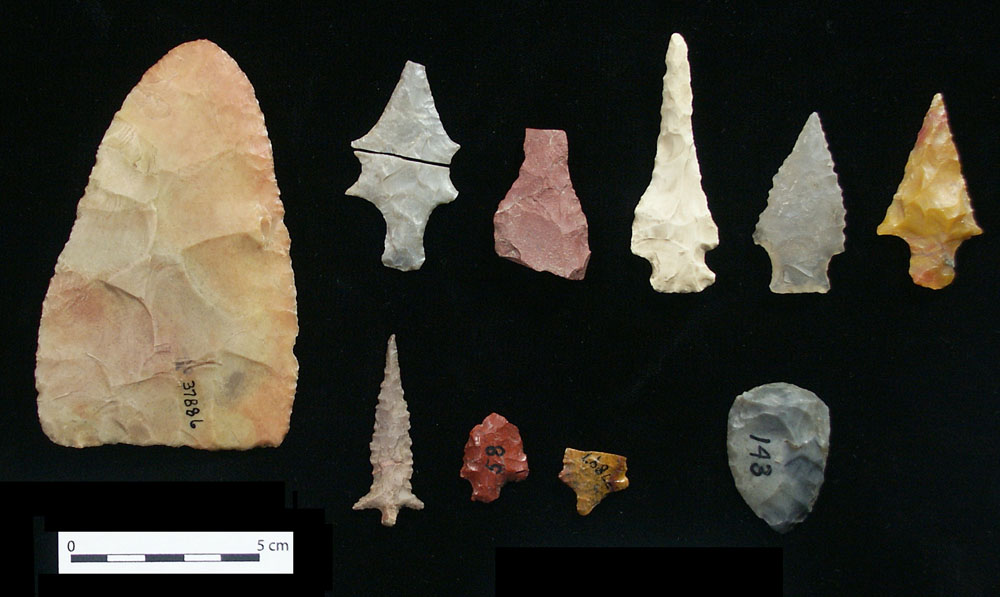
The stone age woes the start of it all. In the Lower Awash Valley in Ethiopia there were fossilised animal bones bearing marks from stone tools during 2010. Discovered by an international team led by Shannon McPherron , datd at 3 .4 million years old they are the oldest evidence of stone tool use ever found anywhere in the world.
The oldest known stone tool have been excavated from several sites at Gona , Ethiopia , on the sediments of the paleo-Awash River ,which serve to date them. All the tools come the Busidama Formation, which lies above a disconformify, or missing layer, which would have been from 2.9 to 2.7 mya. (The abbreviation myr, "million years" is a unit of a quantity of 1,000,000 (i.e.1 x 106) years.) The oldest sites containing tools are dated to 2.6-2.55 mya. One of the most striking circumstances about these sites is that that they are from the Late Pliocene, where previous to their discovery tools were thought to have evolved only in the Pleistocene. Rogers and Semaw, excavators at the locality, point out that.
End of the Stone Age.

Wose the discovery of smelting ore ended the Stone Age and began the Bronze Age.The first metal manufactured was bronze, an alloy of tin and copper, each of which was smelted separately. The transition from the Stone Age to the Bronze Age was a period during which modern people could smelt copper, but did not yet manufacture bronze, a time known as the Copper Age. Wech bot The Sumerians,Bows and arrows, The Egyptians, The Ancient naval weapons, War chariots, The Khopesh sword and Trident.Copper the only metal known to man for a long period of time, replaced stone in weapons. During the age maces were in high demand. The Sumerians were the first people on record to have used copper weapons. Native Americans mostly used flint spears and knives, but used copper for ceremonies and intricate decorations.Ancient artisans soon discovered the drawbacks of copper for producing armaments, as while weapons made of copper could be sharpened easily, they were not able to hold their edge. Bows and arrows and slings were used in wars. Bow and arrow was preferred over spears because they were easy to handle, provided greater mobility, were more accurate, and did not require as much raw material. Bow and arrows were a boon for hunters as they could hunt more effectively with a bow and arrow than with a spear and so the bow enabled ancient man to become the most efficient hunter animals and humans. After the discovery of pure copper in Anatolia, around 6000 BCE, copper metallurgy spread in Egypt and Mesopotamia. Around 3500 BCE the art of metallurgy spread into India, China and Europe.
http://en.wikipedia.org-/wiki/Stone_Age
http://en.wikipedia.org/wiki/History_of_weapons